
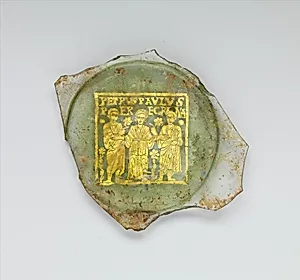
Plate Base with Peregrina between Saints Peter and Paul
Unknown Artist
mid-300s
Medium
Glass, gold leaf
Dimensions
Overall: 4 1/2 x 5 1/4 x 1/2 in. (11.5 x 13.3 x 1.2 cm) diameter of foot: 3 7/8 in. (9.8 cm)
Classification
Glass-Gold glass
Culture
Roman
Department
Medieval Art
Museum
Metropolitan Museum of Art, New York, NY
Credit
Rogers Fund, 1918
Accession Number
18.145.2
Rights
Public Domain
Tags
Art Historical Context
This delicate plate base, crafted in the mid-300s during Rome's late antique period, exemplifies early Christian gold glass—a technique where a thin layer of gold leaf engraved with intricate designs is fused between two sheets of glass. Measuring just 4½ x 5¼ inches overall, with a 3⅞-inch diameter foot, it once formed the sturdy base of a shallow vessel, likely used in daily life or ritual contexts. Housed in the Metropolitan Museum of Art's Art department (acquired via the Rogers Fund in 1918), it reflects the fusion of Roman craftsmanship and emerging Christian devotion. At its center, the artwork depicts a figure named Peregrina—Latin for "pilgrim" or "wanderer"—flanked by Saints Peter and Paul, the foundational apostles of the Church. Peter, with keys symbolizing heavenly authority, and Paul, the missionary to the Gentiles, stand as protective intercessors, a common motif in 4th-century Roman Christian art. This iconography underscores the era's shift from paganism to Christianity, as believers commissioned such personalized objects to invoke saints' blessings, perhaps for memorials, homes, or pilgrims' souvenirs. Gold glass's luminous quality, with its glowing gold visible through translucent layers, made it prized for its durability and ethereal beauty. Surviving examples like this are rare, offering a window into how everyday Romans expressed faith amid the Empire's transformation, blending artistry with spiritual aspiration.