
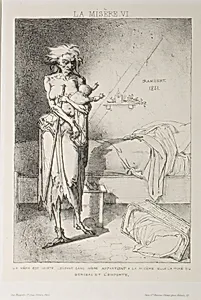
Plate Six from Misery
1851
Medium
Lithograph in black on cream China paper, laid down on ivory wove paper (chine collé)
Dimensions
Image: 23.9 × 17.3 cm (9 7/16 × 6 13/16 in.); Primary support: 27.1 × 19.3 cm (10 11/16 × 7 5/8 in.); Secondary support: 43.3 × 29.7 cm (17 1/16 × 11 3/4 in.)
Classification
lithograph
Department
Prints and Drawings
Museum
Art Institute of Chicago
Accession Number
207052
Rights
Public Domain
Art Historical Context
Charles Rambert’s “Plate Six from Misery,” created in 1851, forms part of a larger series that explores themes of hardship and human suffering. Produced as a lithograph in black on cream China paper using the chine collé technique—where the delicate image is laid onto a sturdier wove sheet—this print exemplifies the mid-nineteenth-century interest in accessible yet refined printmaking. The layered supports allow for crisp detail while ensuring the work’s durability, reflecting the period’s technological advances in lithography that made art more widely available to collectors and the public. Housed in the Art Institute of Chicago’s Department of Prints and Drawings, the piece measures just under ten inches in height, inviting close viewing of its tonal nuances. As one plate within a narrative sequence, it likely contributes to a broader commentary on social conditions prevalent in the 1850s, when artists increasingly turned to print media to address everyday struggles. Rambert’s choice of medium underscores lithography’s role in democratizing imagery during an era of rapid social change.