
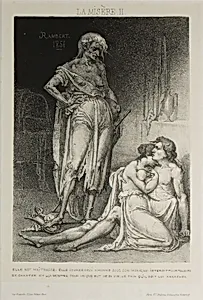
Plate Two from Misery
1851
Medium
Lithograph in black on cream China paper, laid down on ivory wove paper (chine collé)
Dimensions
Image: 24 × 17.2 cm (9 1/2 × 6 13/16 in.); Primary support: 27.4 × 19.5 cm (10 13/16 × 7 11/16 in.); Secondary support: 43.2 × 29.5 cm (17 1/16 × 11 5/8 in.)
Classification
lithograph
Department
Prints and Drawings
Museum
Art Institute of Chicago
Accession Number
207048
Rights
Public Domain
About this artwork
The text on this print translates as, “She is in power, already she bends man under her irony, forever forbids him to sing and shows him the sole purpose of his life; the bread he must tear from her.”
Art Historical Context
Charles Rambert’s “Plate Two from Misery,” created in 1851, offers a glimpse into the power of printmaking to address social themes during a turbulent era in European history. As part of a series exploring hardship and human struggle, the lithograph uses stark contrasts and expressive line work to evoke the emotional weight of its subject. Produced just after the revolutions of 1848, such works often served as accessible commentaries on poverty and resilience for a growing middle-class audience. The choice of medium—a lithograph printed in black on cream China paper using the chine collé technique—reflects the artistic innovations of the mid-nineteenth century. This method, which involves adhering a fine sheet of paper to a sturdier support, allowed for delicate tonal gradations and intricate details while making prints more affordable and widely distributable than paintings. Rambert’s careful attention to the layered supports underscores the technical sophistication of lithographic art at the time. Housed in the Art Institute of Chicago’s Prints and Drawings collection, this piece highlights lithography’s role in democratizing art and preserving visual records of social conditions. Its modest yet refined presentation invites viewers to consider both the personal stories depicted and the broader cultural conversations of the period.