
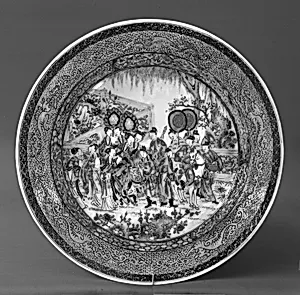
Plate with a narrative scene of the Consort Yang
Unknown Artist
late 18th century
Medium
Porcelain painted in overglaze polychrome enamels (Jingdezhen ware)
Dimensions
Diam. 8 1/8 in. (20.6 cm)
Classification
Ceramics
Culture & Period
China · Qing dynasty (1644–1911)
Department
Asian Art
Museum
Metropolitan Museum of Art, New York, NY
Credit
Purchase by subscription, 1879
Accession Number
79.2.617
Rights
Public Domain
Tags
Art Historical Context
This exquisite porcelain plate from China's Qing dynasty (1644–1911), crafted the late 18th century at renowned Jingdezhen kilns, captures a lively narrative scene featuring the legendary Consort Yang—likely Yang Guifei the beloved imperial consort of Emperor Xuong during the Tang dynasty (618–907). Measuring just over 8 inches in diameter the plate depicts women, men, and horses a dynamic composition, evoking tales of courtly romance, luxury, and drama that have inspired Chinese art for centuries. Such scenes romanticize Yang's beauty and tragic fate, blending history with folklore to delight viewers. The artwork showcases masterful overglaze polychrome enamels, a technique perfected in Jingdezhen during the Qing era, where vibrant hues of pink, green, and gold—often called famille rose—were applied after firing and refired at lower temperatures for a luminous finish. This allowed for intricate details on figures' flowing robes, expressive faces, and spirited horses, making the plate both a functional object and a storytelling canvas. Exported widely, these wares symbolized China's porcelain supremacy and influenced global ceramics. Acquired by subscription in 1879 for the Metropolitan Museum of Art, this piece highlights the Qing court's fascination with Tang-era glamour, offering visitors a window into imperial fantasies preserved in enduring clay.