
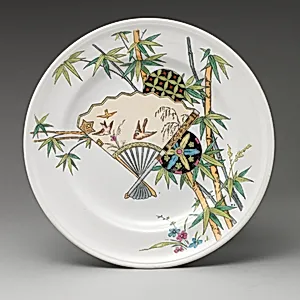
Plate with "Bamboo and Fan" pattern
ca. 1877
Medium
Earthenware
Dimensions
Diameter: 10 13/16 in. (27.5 cm)
Classification
Ceramics-Pottery
Culture
British, Stoke-on-Trent, Staffordshire
Department
European Sculpture and Decorative Arts
Museum
Metropolitan Museum of Art, New York, NY
Credit
Purchase, Robert L. Isaacson Gift, 1991
Accession Number
1991.110.3
Rights
Public Domain
Tags
Art Historical Context
This elegant earthenware plate, produced by the renowned Minton pottery firm in Stoke-on-Tr, Staffordshire, around 1877, exemplifies the era's fascination with exotic motifs. Measuring 10 13/16 inches in, it features the "Bamboo and" pattern, adorned with delicate depictions of bamboo stalks, fans and birds—hallmarks of Japonisme, the Western craze for Japanese art that swept Europe after trade barriers lifted in the mid-19th century. Minton, a leader in British ceramics, mastered earthenware production, creating durable yet refined tableware for affluent households. The plate's design reflects the Aesthetic Movement's emphasis on beauty over utility, blending Eastern elegance with Staffordshire's industrial precision. Likely transfer-printed for efficiency—a technique Minton perfected—its motifs evoke Japan's natural grace, symbolizing resilience (bamboo) and artistry (fans). Such pieces transformed everyday dining into a cultural statement, showcasing Britain's global influences during the height of empire. Today, housed in the Metropolitan Museum of Art's European Sculpture and Decorative Arts collection, this plate highlights Minton's enduring legacy in ceramics innovation, bridging fine art and domestic life. Visitors will appreciate its subtle charm, a window into 19th-century tastemakers' worldly aspirations.
About the Artist
Minton(s) · 1793–2001
Minton is among the most distinguished names in the history of British ceramics, a firm whose two and a quarter centuries of production encompass everything from blue transfer-printed earthenwares to the most rarefied decorative porcelain of the Victorian age. The company was founded in 1793 by Thomas Minton (1765–1836) in Stoke-upon-Trent, Staffordshire — the heart of England's pottery industry. ...