
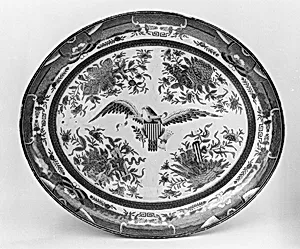
Platter
Unknown Artist
late 18th–early 19th century
Medium
Hard-paste porcelain
Dimensions
Overall: 18 1/2 × 15 5/8 in. (47 × 39.7 cm)
Classification
Ceramics-Porcelain-Export
Culture
Chinese, for American market
Department
European Sculpture and Decorative Arts
Museum
Metropolitan Museum of Art, New York, NY
Credit
Helena Woolworth McCann Collection, Gift of Winfield Foundation, 1951
Accession Number
51.86.129
Rights
Public Domain
Tags
Art Historical Context
This elegant platter, crafted by an unknown Chinese artist in late 18th to early 19th century measures a generous 18½ × 15⅝ inches (47 × 39.7 cm), making it a striking centerpiece for any table. Produced as export porcelain specifically for the American market, it delicate motifs of birds, flowers and a central coat of arms—hallmarks of customized Chinese ceramics tailored to Western tastes during the height of the China Trade. -paste porcelain, the medium here, represents a pinnacle of Chinese ceramic innovation: made from kaolin clay and fired at intense temperatures over 1,200°C, it achieves exceptional strength, translucency, and a resonant "ping" when tapped. Artisans in export workshops, likely in Canton (Guangzhou), masterfully painted these designs, blending traditional floral and avian symbolism with European-style heraldry to appeal to affluent American buyers seeking status symbols for their homes. Housed in the Metropolitan Museum of Art's Department of European Sculpture and Decorative Arts, this piece from the Helena Woolworth McCann Collection (gifted by the Winfield Foundation in 1951) highlights the vibrant cultural exchanges of the early American republic, when trans-Pacific trade brought East Asian artistry into everyday life.