
Playing Cards
c. 1470
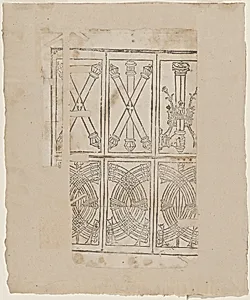
Medium
woodcut
Dimensions
sheet: 39 × 32.5 cm (15 3/8 × 12 13/16 in.)
Classification
Department
CG-E
Museum
National Gallery of Art, Washington, D.C.
Credit
Rosenwald Collection
Accession Number
1944.8.23
Rights
Public Domain
Art Historical Context
**Playing Cards**, a captivating woodcut print from Italy around 1470, offers a glimpse into the dawn of the Renaissance and the rise of printmaking. Created by an anonymous artist of the 15th century, this sheet measures 39 × 32.5 cm and captures a complete set of playing cards in single, bold composition. Housed in the National Gallery of Art's Rosenwald Collection (Department CG-E), it exemplifies early graphic design ingenuity. Woodcuts like this were revolutionary, as carvers incised images into wooden blocks, inking them to produce multiple impressions on paper—a technique that democratized art and games. By the late 1400s, playing cards had evolved from hand-painted luxuries for the elite into affordable printed entertainment across Europe, fueling social pastimes, gambling, and even early mass culture. This artwork reflects Italy's vibrant print workshops, where such innovations bridged art and everyday life. Fun fact: Surviving examples are rare, making this a treasure for understanding how Renaissance ingenuity turned leisure into an accessible printed phenomenon. Visitors, imagine the lively taverns where these cards sparked laughter and strategy!