
Plowing
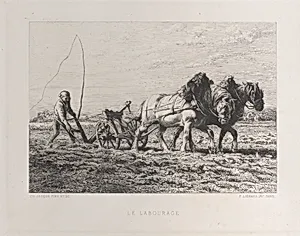
Medium
Etching
Dimensions
Sheet: 12 3/16 × 18 7/8 in. (31 × 48 cm) Plate: 10 5/8 × 8 7/16 in. (27 × 21.5 cm)
Classification
Prints
Department
Drawings and Prints
Museum
Metropolitan Museum of Art, New York, NY
Credit
The Elisha Whittelsey Collection, The Elisha Whittelsey Fund, 1962
Accession Number
63.625.436
Rights
Public Domain
Tags
Art Historical Context
**Plowing**, a captivating etching from 1864 by French artists Charles Jacque and Liénard, transports viewers to the timeless rhythm of rural life. Jacque, a prominent figure in the Barbizon school was renowned for his pastoral scenes featuring animals and peasants at work. This collaborative print depicts sturdy horses pulling a plow through furrowed fields, guided by determined men—a poignant snapshot of 19th-century French agriculture during the Second Empire era, when industrialization loomed but the countryside still embodied traditional labor and harmony with nature. Rendered in etching, a meticulous intaglio technique where acid etches intricate lines into a metal plate, the work showcases Jacque's mastery of texture and movement. The plate measures 10 5/8 × 8 7/16 inches, allowing for fine details in the horses' muscles, the plow's gleam, and the earth's soft contours. Etchings like this were prized for their affordability, making high art accessible beyond oil paintings and democratizing scenes of everyday heroism. Housed in the Metropolitan Museum of Art's Drawings and Prints department as part of The Elisha Whittelsey Collection (acquired 1962), *Plowing* celebrates the dignity of rural toil. It invites us to pause and appreciate the quiet beauty in humanity's bond with the land, a theme that resonated deeply in an age of rapid change.
About the Artist
Charles Jacque|François Liénard · 1813–1894
Charles-Émile Jacque (1813–1894) was a pioneering French painter, engraver, and illustrator whose career bridged the worlds of printmaking and pastoral painting. Born in Paris amid a difficult childhood, he apprenticed at age seventeen to a map engraver, mastering drypoint technique and producing his first etching in 1830—a copy of a head after Rembrandt. After serving seven years in the French Ar...