
Plums
Medium
Watercolor, graphite, and gouache on off-white Bristol board
Dimensions
7 1/8 x 12 in. (18.1 x 30.5 cm)
Classification
Watercolor
Culture
American
Department
The American Wing
Museum
Metropolitan Museum of Art, New York, NY
Credit
Gift of J. Henry Hill, 1882
Accession Number
82.9.1
Rights
Public Domain
Tags
Art Historical Context
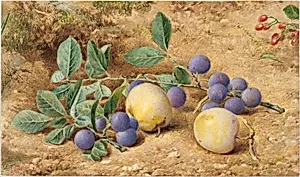
John William Hill’s *Plums* (1870) captures the quiet beauty of everyday fruit with remarkable precision. Created in the United States during a period when still-life painting flourished among American artists, the small watercolor celebrates the simple abundance of nature. The composition focuses on several ripe plums, their soft skins and subtle shadows inviting close inspection and reminding viewers of the seasonal rhythms of 19th-century American life. Hill worked in a delicate combination of watercolor, graphite, and gouache on Bristol board. This mixed technique allowed him to achieve both fine linear detail and rich, luminous color, giving the plums a tangible sense of weight and freshness. The modest size—just over seven by twelve inches—encourages an intimate viewing experience, typical of works meant for private contemplation rather than grand public display. Now part of the Metropolitan Museum’s American Wing, *Plums* entered the collection as a gift from J. Henry Hill in 1882. It stands as a fine example of American still-life tradition, demonstrating how artists of the era used accessible media to elevate ordinary subjects into lasting works of art.
About the Artist
John William Hill · 1812–1879
American (born England), London 1812–1879 West Nyack, New York