
Pluto and Cerberus
early 17th century
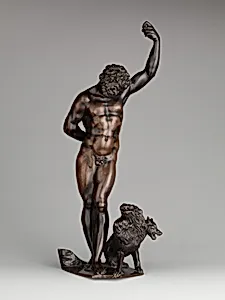
Medium
Bronze
Dimensions
Height: 11 3/8; Width (elbow to forearm): 3 5/8; maximun depth (diagonal from tree trunk support behind leg to front edge of base): 5 1/16 in. (28.9 x 9.2 x 12.9 cm); Wt. 6lb. (2.7216kg)
Classification
Sculpture-Bronze
Culture
French
Department
European Sculpture and Decorative Arts
Museum
Metropolitan Museum of Art, New York, NY
Credit
Gift of Mrs. Howard J. Sachs and Mr. Peter G. Sachs, in memory of Miss Edith L. Sachs, 1978
Accession Number
1978.516.6
Rights
Public Domain
Tags
Art Historical Context
In the early 17th century, sculptor Giovanni Battista di Jac crafted this captivating bronze sculpture, *Pluto and Cerber*, now a treasured piece in the Metropolitan Museum of Art Department of European Sculpture and Decorative Arts. Standing just 11⅜ inches tall, this diminutive yet dynamic work exemplifies the era's fascination with classical mythology, rendered in the enduring medium of bronze. The lost-wax casting technique allowed for intricate details, from the god's muscular form to the snarling hounds, making it a prized collector's item for Renaissance and Baroque elites. The subject draws from Roman lore: Pluto, ruler of the underworld, is depicted in a nude, heroic pose alongside Cerberus, the fearsome three-headed dog guarding Hades' gates. This male nude celebrates anatomical prowess and mythological drama, blending French elegance with Italianate influences evident in the artist's name. The subtle tree trunk support behind Pluto's leg adds stability while evoking naturalism, a nod to antique prototypes. Weighing a mere six pounds, its compact dimensions (width 3⅝ inches, depth 5¹/₁₆ inches) suited private cabinets or tabletops, symbolizing wealth and erudition. Gifted in 1978 in memory of Edith L. Sachs, it invites visitors to ponder the timeless allure of gods and beasts in miniature bronze perfection.
About the Artist
Giovanni Battista di Jacopo · 1494–1540
**Giovanni Battista di Jacopo (1494/1495–1540), better known as Rosso Fiorentino or Il Rosso (“the Redhead”), was a leading Italian Mannerist painter of the Florentine school.** Born in Florence with the striking red hair that inspired his nickname, he trained in the studio of Andrea del Sarto alongside his contemporary Jacopo Pontormo. His early works, such as the *Cherub Playing a Lute* (Uffizi...