
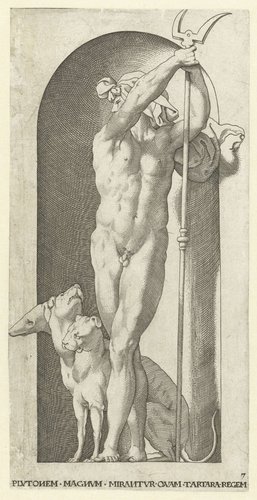
Pluto met tweetand en Cerberus
1530
Medium
engraving
Dimensions
108; 212
Rights
Public Domain
About this artwork
Pluto, god van de onderwereld, met zijn attributen een tweetand en de driekoppige hond Cerberus die de ingang van de onderwereld bewaakt. In het onderschrift PLVTONEM MAGNVM MIRANTVR QVAM TARTARA REGEM wordt de god geroemd als koning van Tartarus, de plaats waar zondaars werden gefolterd. Kopie naar een prent van Giovanni Jacopo Caraglio.
Art Historical Context
Jacob Binck’s 1530 engraving presents Pluto, the Roman god of the underworld, standing with his distinctive attributes: a two-pronged staff and the three-headed watchdog Cerberus. The small print, measuring just over 21 centimeters in height, captures the deity as ruler of Tartarus the realm where sinners faced eternal punishment. A Latin inscription beneath the figure praises him as the “great king of Tartarus,” underscoring the Renaissance fascination with classical mythology and its moral lessons. Binck, a German engraver active in the early sixteenth century, produced this work as a direct copy after an Italian print by Giovanni Jacopo Caraglio. Such reproductive engravings played a vital role in spreading Italian Renaissance imagery across northern Europe. The precise line work typical of the medium allowed fine details—such as Cerberus’s alert heads and Pluto’s commanding pose—to be reproduced and collected by a growing audience of scholars and art lovers. Today the engraving offers a compact window into how sixteenth-century artists reinterpreted ancient gods for new viewers, blending classical subject matter with the technical refinement of printmaking.