
Pocket Bottle
Unknown Artist
ca. 1820
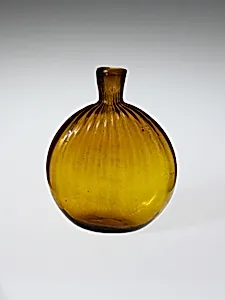
Medium
Blown pattern-molded lead glass
Dimensions
H. 5 1/4 in. (13.3 cm)
Classification
Pocket bottle
Culture
American
Department
The American Wing
Museum
Metropolitan Museum of Art, New York, NY
Credit
Gift of Frederick W. Hunter, 1913
Accession Number
13.179.3
Rights
Public Domain
Art Historical Context
Nestled in The American Wing of the Metropolitan Museum of Art, this delicate *Pocket Bottle* (ca. 1820) exemplifies early 19th-century American glassmaking ingenuity. Standing just 5 1/4 inches tall, its petite size made it perfectly suited for slipping into a gentleman's pocket—likely to hold whiskey, medicine, or other elixirs during travel or daily errands. Crafted by an unknown artist, the bottle was generously gifted to the Museum by Frederick W. Hunter in 1913, preserving a slice of everyday Americana. The medium, blown pattern-molded lead glass, highlights innovative techniques of the era. Glassmakers blew molten lead glass—a brilliant, refractive material akin to fine crystal—into a mold that imparted repeating patterns, allowing for affordable yet decorative production. This method flourished in American factories like those in Pittsburgh and New England, as the young nation sought self-sufficiency after independence, rivaling European imports. The result is a functional object elevated by subtle elegance, its swirling motifs catching light with a sparkling allure. As a cultural artifact, the *Pocket Bottle* whispers of 1820s social habits: the rise of portable luxuries amid westward expansion and industrialization. Though humble, it reflects America's budding artisanal pride and the democratizing of beauty in daily life. Visitors, imagine toting this shimmering companion on a frontier journey!