
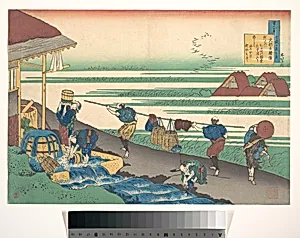
百人一首 うばがゑとき 大納言経信|Poem by Dainagon Tsunenobu (Minamoto no Tsunenobu, Katsura no Dainagon), from the series One Hundred Poems Explained by the Nurse (Hyakunin isshu uba ga etoki)
Medium
Woodblock print; ink and color on paper
Dimensions
Image: 9 15/16 × 14 3/8 in. (25.2 × 36.5 cm) Mat: 22 3/4 × 15 1/2 in. (57.8 × 39.4 cm)
Classification
Prints
Culture & Period
Japan · Edo period (1615–1868)
Department
Asian Art
Museum
Metropolitan Museum of Art, New York, NY
Credit
The Howard Mansfield Collection, Purchase, Rogers Fund, 1936
Accession Number
JP2549
Rights
Public Domain
Tags
Art Historical Context
Created by the renowned ukiyo-e master Katsushika Hokusai in 1839, this wood print belongs to his ambitious series *One Hundred Poems Explained by the Nurse* (*Hyakunin isshu uba ga etoki*). The work illustrates a poem by the Heian-period courtier Minamoto no Tsunenobu, reimagining classical waka verse through scenes of everyday life. Produced during Japan’s Edo period, when color woodblock prints reached new heights of popularity, the print reflects Hokusai’s late-career interest in making aristocratic poetry accessible to a broad audience. Rendered in ink and color on paper, the composition employs the dynamic line work and subtle gradations typical of ukiyo-e. Everyday figures—men and women engaged in domestic tasks amid simple houses—bring the poem’s themes to life, bridging literary tradition with the rhythms of ordinary existence. Such prints were widely circulated, allowing viewers to appreciate both visual storytelling and poetic heritage. Now in the Metropolitan Museum of Art’s collection, this sheet exemplifies Hokusai’s ability to fuse literature, landscape, and human activity. It offers today’s visitors a vivid window into Edo-period culture and the enduring appeal of Japan’s classical poetry.
About the Artist
Katsushika Hokusai · 1760–1849
Katsushika Hokusai (1760-1849) stands as one of history's most influential artists, a Japanese master who revolutionized the ukiyo-e woodblock print tradition and profoundly shaped Western art. Born in the Katsushika district of Edo (modern-day Tokyo) to an artisan family, Hokusai lived through nearly nine decades of extraordinary creative evolution, adopting over thirty different artistic names t...