
百人一首 うはかゑとき 源宗于朝臣|Poem by Minamoto no Muneyuki Ason, from the series One Hundred Poems Explained by the Nurse (Hyakunin isshu uba ga etoki)
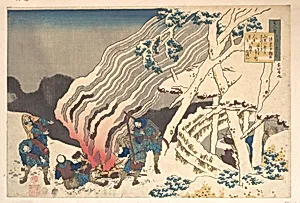
Medium
Woodblock print; ink and color on paper
Dimensions
H. 9 7/8 in. (25.1 cm); W. 14 5/8 in. (37.1 cm)
Classification
Prints
Culture & Period
Japan · Edo period (1615–1868)
Department
Asian Art
Museum
Metropolitan Museum of Art, New York, NY
Credit
Rogers Fund, 1914
Accession Number
JP6
Rights
Public Domain
Tags
Art Historical Context
Katsushika Hokusai, the legendary Japanese artist renowned for his ukiyo-e woodblock prints like *The Great Wave off Kanagawa*, created this evocative piece in 1839 during the Edo period (1615–1868). Titled *Poem by Minamoto no Muneyuki Ason* from the series *One Hundred Poems Explained by the Nurse (Hyakunin isshu uba ga etoki)*, it visually interprets a verse from the famed *Hyakunin Isshu* anthology—a collection of 100 classical waka poems by Japan's greatest poets, often used in games and storytelling. Here, Hokusai illustrates Minamoto no Muneyuki's poignant poem evoking the hardships of winter travel, blending poetry with vivid imagery. The print, in ink and color on paper (measuring about 10 x 14.5 inches), masterfully captures a snowy landscape with rugged hills, barren trees, and a sense of isolation and suffering. Hokusai's ukiyo-e technique shines through his bold use of color gradients—deep blues and whites for snow—and dynamic composition, drawing viewers into the poem's emotional chill. Woodblock printing, a collaborative process involving carvers and printers, made such art accessible to everyday people, democratizing high culture. This work highlights the cultural fusion of literature and visual art in Edo Japan, where prints like this preserved poetic traditions while showcasing nature's sublime beauty and human endurance. A gem in the Metropolitan Museum of Art's Asian Art collection, it invites visitors to ponder poetry's timeless power.
About the Artist
Katsushika Hokusai · 1760–1849
Katsushika Hokusai (1760-1849) stands as one of history's most influential artists, a Japanese master who revolutionized the ukiyo-e woodblock print tradition and profoundly shaped Western art. Born in the Katsushika district of Edo (modern-day Tokyo) to an artisan family, Hokusai lived through nearly nine decades of extraordinary creative evolution, adopting over thirty different artistic names t...