
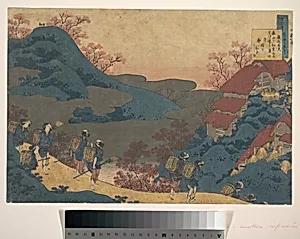
百人一首 乳母かゑとき 猿丸太夫|Poem by Sarumaru Dayū, from the series One Hundred Poems Explained by the Nurse (Hyakunin isshu uba ga etoki)
Medium
Woodblock print; ink and color on paper
Dimensions
H. 10 in. (25.4 cm); W. 14 3/8 in. (36.5 cm)
Classification
Prints
Culture & Period
Japan · Edo period (1615–1868)
Department
Asian Art
Museum
Metropolitan Museum of Art, New York, NY
Credit
H. O. Havemeyer Collection, Bequest of Mrs. H. O. Havemeyer, 1929
Accession Number
JP1852
Rights
Public Domain
Tags
Art Historical Context
This enchanting woodblock print by Katsushika Hokus, created in 1839 during Japan's Edo period, captures a tender moment from his series *One Hundred Poems by the Nurse* (*Hyakunin isshua ga etoki*). It depicts the poem by the 9th-century poet Saru Dayū, with a nurse (uba) illustrating its essence to wide children amid a rustic landscape of houses, trees, and distant mountains. Hokusai, the ukiyo-e master famed for *The Great Wave off Ka wa*, was in his late 70s, blending everyday life with poetic tradition in his signature vibrant inks and colors on paper. The *Hyakunin Isshu*, a revered anthology of 100 waka poems compiled in the 13th century, was a cultural touchstone for education and entertainment. Hokusai's series democratized it through accessible visuals, making classical literature lively for commoners via woodblock printing—a revolutionary medium that allowed mass production. The intimate scale (10 x 14 inches) invites viewers into this storytelling scene, where human figures harmonize with nature, evoking themes of transience and nostalgia central to Japanese poetry. Housed in the Metropolitan Museum of Art's Asian Art collection, this print exemplifies Hokusai's genius for narrative composition and his enduring influence on global art, from Impressionism to modern design. A delightful window into Edo-era Japan!
About the Artist
Katsushika Hokusai · 1760–1849
Katsushika Hokusai (1760-1849) stands as one of history's most influential artists, a Japanese master who revolutionized the ukiyo-e woodblock print tradition and profoundly shaped Western art. Born in the Katsushika district of Edo (modern-day Tokyo) to an artisan family, Hokusai lived through nearly nine decades of extraordinary creative evolution, adopting over thirty different artistic names t...