
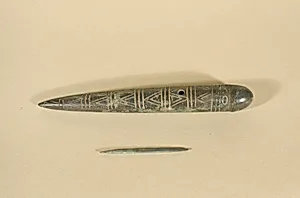
Pointed Tubular Tool with Pin
Unknown Artist
1st millennium BCE
Medium
Bronze
Dimensions
a: L. 6 7/8 in. (17.5 cm) b: L. 2 5/8 in. (6.7 cm)
Classification
Metalwork
Culture
China
Department
Asian Art
Museum
Metropolitan Museum of Art, New York, NY
Credit
Gift of Katherine and George Fan, 2003
Accession Number
2003.66.9a, b
Rights
Public Domain
Art Historical Context
This intriguing bronze artifact, titled *Pointed Tubular Tool Pin*, hails from China during the 1st BCE—a pivotal era in the Bronze Age when advanced metallurgy flourished. Crafted in two parts (one measuring 6⅞ inches long and the other 2⅝ inches), this metalwork piece exemplifies the precision of ancient Chinese bronze casting techniques, likely employing the sophisticated piece-mold method that allowed for intricate forms. Donated to the Metropolitan Museum of Art 2003 by Katherine and George Fan, it resides in the Asian Art department, offering a glimpse into a time when bronze was not just for elite ritual vessels but also practical tools. Though its exact function remains a mystery—possibly an awl, needle, or weaving implement—the tool's pointed tubular design and accompanying pin highlight the ingenuity of everyday craftsmanship in ancient China. During this period, from the late Shang to Eastern Zhou dynasties, bronze production reached extraordinary levels, symbolizing technological prowess and cultural innovation. Such utilitarian objects, rarer in collections than ornate bronzes, provide valuable insights into the lives of artisans and common folk, bridging the gap between monumental art and daily utility. Visitors to the Met will appreciate how this modest yet masterful piece underscores China's enduring legacy in metalwork, reminding us that even the smallest tools can reveal volumes about a civilization's skill and spirit.