
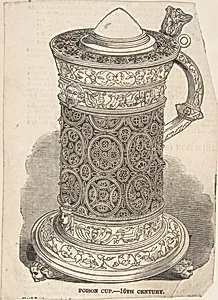
Poison Cup - 16th century
second half 19th century
Medium
Wood engraving
Dimensions
sheet: 4 1/2 x 3 1/4 in. (11.4 x 8.3 cm)
Classification
Prints
Department
Drawings and Prints
Museum
Metropolitan Museum of Art, New York, NY
Credit
The Elisha Whittelsey Collection, The Elisha Whittelsey Fund, 1960
Accession Number
60.632.129(4)
Rights
Public Domain
Tags
Art Historical Context
This intriguing wood engraving titled *Poison Cup - 16th century* offers a glimpse into how Victorian audiences engaged with the dramatic history of the Renaissance. Created in the second half of the 19th century by an anonymous British artist, the small print measures just 4½ by 3¼ inches. It was produced using wood engraving, a precise technique that allowed for fine detail and was widely used to illustrate books and scholarly publications during the era. The subject depicts a cup associated with poisoning—a sinister practice linked to political intrigue and courtly danger in 16th-century Europe. Though the original object may no longer survive, this 19th-century interpretation reflects the period’s fascination with historical artifacts and sensational stories from the past. Such prints often appeared in catalogs or studies of decorative arts, helping to preserve visual records of rare or vanished treasures. Now part of the Metropolitan Museum of Art’s collection in the Department of Drawings and Prints, the work was acquired through the Elisha Whittelsey Fund in 1960. It serves as a reminder of how printmaking bridged centuries, allowing later generations to study and appreciate the craftsmanship and darker narratives of earlier times.
About the Artist
Anonymous, British, 19th century · 1800–1900
**Anonymous, British, 19th century** is not the name of a single individual but a standard museum attribution used for works whose creators remain unidentified yet are clearly British and date to the 1800s. Major institutions, including the Metropolitan Museum of Art, employ this designation for hundreds of drawings, prints, designs, and decorative studies that lack signatures or firm documentary ...