
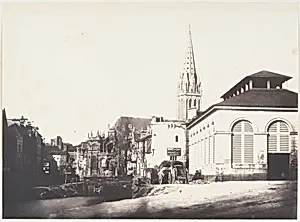
Poissonerie, Caen
1852–54
Medium
Salted paper print from glass negative
Dimensions
24.6 x 33.5 cm (9 11/16 x 13 3/16 in. )
Classification
Photographs
Department
Photographs
Museum
Metropolitan Museum of Art, New York, NY
Credit
Harris Brisbane Dick Fund, 1995
Accession Number
1995.96.27
Rights
Public Domain
Tags
About this artwork
This remarkable salted paper print documents the fish market (poissonerie) in Caen, Normandy, capturing the architectural heritage and daily commerce of mid-nineteenth-century France. Created by Edmond Bacot between 1852 and 1854, the photograph exemplifies early French photography's dual commitment to architectural documentation and artistic expression. Bacot, who lived from 1814 to 1875, was a man of independent means in Caen who dedicated himself to photographing the Gothic monuments and urba...
Art Historical Context
Step into the bustling fish market of Caen,, through *Poissonerie, Caen a salted paper print by Edmond Bacot from 2–54. This early photograph captures the vibrant daily commerce and architectural heritage of mid-nineteenth-century France featuring towns, buildings, bridges, carts alive with activity. Bacot, a wealthy resident of Caen (1814–1875), dedicated his life to documenting Normandy's Gothic monuments and urban during photography's formative years, establishing himself as one of three photographers in Lower Normandy. The salted paper process—one of the earliest techniques—involved coating paper with salt and silver nitrate, yielding a matte surface and warm tonality that set it apart from later albumen prints. From a glass negative, this 24.6 x 33.5 cm image blends precise architectural documentation with artistic sensitivity, reflecting French photography's pioneering spirit. Bacot's work gained literary prestige when he gifted similar Norman photos to exiled Victor Hugo on the Isle of Jersey in 1852, earning high praise and even teaching photography to Hugo's son Charles. Acquired by The Metropolitan Museum of Art in 1995 via the Harris Brisbane Dick Fund, it celebrates Bacot's enduring contribution to preserving provincial French life.