
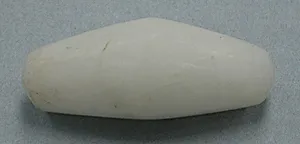
Polishing Stone (pulidor)
Unknown Artist
before 16th century
Medium
Stone
Dimensions
Length 1-3/4 in.
Classification
Stone-Implements
Culture
Mexican
Department
Arts of Africa, Oceania, and the Americas
Museum
Metropolitan Museum of Art, New York, NY
Credit
Bequest of Arthur M. Bullowa, 1993
Accession Number
1994.35.223
Rights
Public Domain
Art Historical Context
This unassuming yet essential *Polishing Stone (pulidor)* hails from pre-16th century Mexico, testament to the ingenuity of ancient Mesoamerican cultures before European contact. Crafted from durable stone and measuring just 1-3/4 inches in length, this compact tool exemplifies the practical artistry of pre-Columbian artisans. Its smooth, ergonomic shape—likely carefully shaped by hand—suggests it was designed for precision work, fitting comfortably in the palm for repetitive polishing tasks. In the hands of Mexican stoneworkers, the pulidor played a vital role in crafting finer objects, from jewelry and ceremonial items to architectural elements. Such implements reveal a sophisticated understanding of materials and techniques, where hardness and texture were harnessed to refine softer stones like jade or obsidian. Far from mere utility, these tools highlight the cultural emphasis on craftsmanship, integral to daily life, rituals, and trade in thriving societies like those of the Aztecs or their predecessors. Today, this artifact graces the Metropolitan Museum of Art's Department of Arts of Africa, Oceania, and the Americas, thanks to the 1993 bequest of Arthur M. Bullowa. It invites us to appreciate the unsung heroes of ancient innovation, bridging the gap between function and the birth of enduring beauty.