
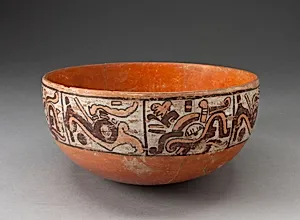
Polychrome Bowl Depicting Eight Abstract Motifs on Exterior
1200–1521
Medium
Ceramic and pigment
Dimensions
9.2 × 19.7 cm (3 5/8 × 7 3/4 in.)
Classification
bowl
Department
Arts of the Americas
Museum
Art Institute of Chicago
Accession Number
111247
Rights
Public Domain
Art Historical Context
This exquisite polychrome bowl hails from Cholula, a vibrant pre-Columbian center in Mexico during the Late Postclassic period (1200–1521). Crafted from ceramic with vibrant pigments, it measures a compact 9.2 × 19.7 cm, perfect for both practical use and ceremonial display. The bowl's exterior boldly features eight abstract motifs, rendered in the distinctive Cholula style of slip-painting—where colored clays are applied before firing to create durable, glossy hues of red, yellow, black, and white. Cholula artisans were masters of this technique, producing some of Mesoamerica's finest pottery, often linked to the Mixteca-Puebla cultural sphere. These abstract designs likely held symbolic power, evoking natural forces, deities, or cosmological patterns central to Cholulan worldview. Such bowls were elite objects, possibly used in rituals or feasts, showcasing the region's advanced ceramic technology and aesthetic sophistication just before European contact in 1521. Today, housed in the Art Institute of Chicago's Arts of the Americas collection, this bowl offers a window into Cholula's enduring legacy—a hub of pilgrimage and artistry that blended utility with profound cultural expression.