
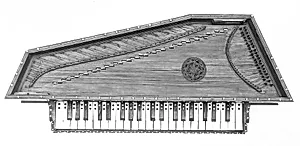
Polygonal Virginal converted to a Tangent Piano
1585 or 1587; converted in 1717
Medium
Cypress, ebony, ivory, various materials
Dimensions
Case length: 31.7 cm
Classification
Chordophone-Zither
Culture
Italian
Department
Musical Instruments
Museum
Metropolitan Museum of Art, New York, NY
Credit
The Crosby Brown Collection of Musical Instruments, 1889
Accession Number
89.4.2765
Rights
Public Domain
Art Historical Context
This remarkable instrument began life as a polygonal virginal crafted by the Italian maker Franciscus Bonafinis around 1585–1587. Virginals were popular household keyboard instruments during the Renaissance, valued for their compact size and bright tone. In 1717, the instrument was converted into a tangent piano, an early form of struck-string keyboard that foreshadowed the modern piano. Such modifications reflect changing musical tastes as composers sought greater dynamic expression. Measuring just 31.7 cm in length, this exceptionally small example would have suited intimate domestic settings. Its case of cypress wood, accented with ebony and ivory, showcases the refined craftsmanship typical of Italian instrument makers. The transformation from plucked to struck mechanism highlights the inventive spirit of musicians and builders across two centuries. Housed in the Metropolitan Museum’s Crosby Brown Collection, the instrument offers visitors a tangible connection to the evolution of keyboard technology and the enduring appeal of portable musical instruments in Italian culture.