
Pompeiian Wall Decoration
1751 to 1775
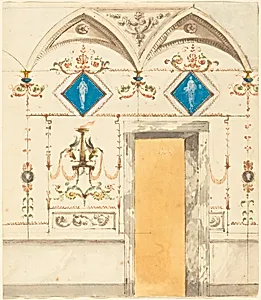
Medium
watercolor and gouache with gray and brown wash and pen and brown ink over graphite on wove paper
Dimensions
sheet: 20.2 x 17.5 cm (7 15/16 x 6 7/8 in.)
Classification
Drawing
Department
CG-E
Museum
National Gallery of Art, Washington, D.C.
Credit
Joseph F. McCrindle Collection
Accession Number
2009.70.43
Rights
Public Domain
Art Historical Context
Giuseppe Bernardino Bison's *Pompeiian Wall Decoration (ca. 1751–1775) captures the allure of ancient Roman frescoes a delicate drawing on wove paper, measuring just 20.2 x 17.5 cm. This intricate work, now in the National Gallery of Art's F. McCrindle, showcases Bison's skill as a Venetian artist known for his architectural fantasies and ornamental designs. Rendered in watercolor and gouache with gray and brown washes, accented by pen and brown over graphite, it evokes vibrant, illusionistic murals unearthed from Pompeii and Herculaneum. Created amid the 18th-century neoclassical revival, the piece reflects Europe's fascination with classical antiquity following the 1748 rediscovery of Pompeii. Bison, active in Venice, drew inspiration from these sites to reinterpret their flat, colorful panels—often featuring motifs like garlands, friezes, and architectural illusions—for contemporary tastes. Wove paper, a relatively new invention by this era, provided a smooth surface ideal for precise layering and luminous effects. This drawing highlights the era's blend of scholarship and artistry, serving as both a study and a design proposal for interior decoration. Visitors will appreciate how Bison bridges ancient splendor with Rococo elegance, inviting us to imagine opulent 18th-century rooms alive with Roman echoes.
About the Artist
Giuseppe Bernardino Bison · 1762–1844
Born 16 June 1762; died 24 August 1844. Comment on works: Landscapes