
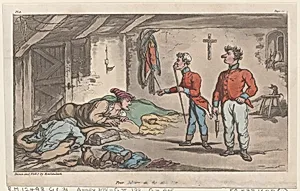
Poor Johnny on the sick list
Medium
Hand-colored etching and aquatint
Dimensions
Sheet: 4 7/8 × 7 11/16 in. (12.4 × 19.5 cm)
Classification
Prints
Department
Drawings and Prints
Museum
Metropolitan Museum of Art, New York, NY
Credit
The Elisha Whittelsey Collection, The Elisha Whittelsey Fund, 1959
Accession Number
59.533.1623(11)
Rights
Public Domain
Tags
Art Historical Context
"**Poor Johnny on the Sick List (1815) is a delightful yet cheeky hand-colored etching and aquat by the prolific British caricaturist Thomas Rowlandson, by Patrick Martin & Co Measuring just 4 7/8 × 7 11/16 inches, this compact print captures a soldier—likely a nod to the beleaguered "Johnny" British military lore—laid low by illness, surrounded by the absurdities of camp life. Rowlandson, a master of Regency-era satire, infuses the scene with his signature exaggerated humor, poking fun at the hardships faced by troops amid the Napoleonic Wars' final throes, including the Battle of Waterloo that same year. The medium shines here: etching provides crisp, witty lines for Rowlandson's dynamic figures, while aquatint adds tonal depth to evoke the gritty atmosphere of a makeshift hospital. Hand-coloring brings vibrant life to the chaos—ruddy faces, tattered uniforms, and comical props—making these affordable prints hugely popular with 19th-century audiences seeking levity amid wartime anxiety. Housed in the Metropolitan Museum of Art's Elisha Whittelsey Collection, this work exemplifies Rowlandson's keen eye for social commentary, blending empathy for soldiers with bawdy exaggeration. It offers a window into early 19th-century British culture, where laughter was a balm for the era's uncertainties.
About the Artist
Thomas Rowlandson|Patrick Martin & Co · 1756–1827
Thomas Rowlandson (1757–1827) was an English artist and caricaturist whose satirical watercolors and prints captured the social life of Georgian Britain with unparalleled wit and technical mastery. Alongside James Gillray, he is recognized as one of the greatest British graphic artists, and his distinctive flowing line and keen observations have made his work integral to understanding late 18th an...