
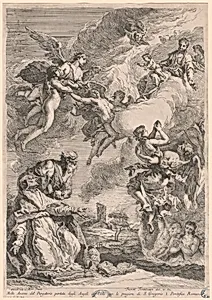
Pope Gregory the Great and Saint Vitale Interceding for the Souls in Purgatory
Medium
etching on laid paper
Dimensions
plate: 45.2 × 31.6 cm (17 13/16 × 12 7/16 in.) sheet: 45.6 × 32.1 cm (17 15/16 × 12 5/8 in.)
Classification
Department
CG-E
Museum
National Gallery of Art, Washington, D.C.
Credit
Gift of Karin Wachtel in memory of her husband, Cesare Morini
Accession Number
2014.117.1
Rights
Public Domain
Art Historical Context
In the grand tradition of Venetian Baroque art, this striking etching captures a moment of divine intercession: *Pope Gregory the Great and Vitale Interceding for Souls in Purgatory*. around 1731 by Francesco Fonteasso after a composition by his mentor Sebastiano Ricci, it exemplifies the dramatic, emotive style of 18-century Venice. Fontebasso, a skilled printmaker, faithfully translates Ricci's lush painting into intricate lines, allowing the master's vision to reach a wider audience through the accessible medium of print. Etching on laid paper—a technique where acid etches fine, expressive lines into a metal plate—brings to life swirling clouds of tormented souls rising toward the saints' benevolent gestures. Pope Gregory the Great (c. 540–604), a key figure in early Christian theology, is famously linked to medieval visions of Purgatory, a Catholic doctrine of purification after death. Saint Vitale, a Ravenna martyr, joins him in this plea for mercy, reflecting the era's fervent devotion to salvation and the afterlife. Measuring about 45 x 32 cm, this print from the National Gallery of Art's collection (gift of Karin Wachtel in memory of Cesare Morini) highlights how prints democratized Baroque grandeur, blending spiritual drama with technical virtuosity for enduring inspiration.