
Porringer
1761–99
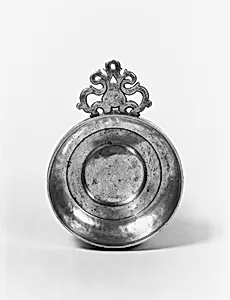
Medium
Pewter
Dimensions
1 3/4 x 7 1/8 x 5 in. (4.4 x 18.1 x 12.7 cm)
Classification
Porringer
Culture
American
Department
The American Wing
Museum
Metropolitan Museum of Art, New York, NY
Credit
Gift of Mrs. J. Insley Blair, in memory of her husband, 1940
Accession Number
40.184.7
Rights
Public Domain
Art Historical Context
Nestled in the Metropolitan Museum of Art's American Wing, this elegant pewter porringer by Frederick Bassett (1761–99) offers a glimpse into everyday colonial American life. Crafted during the late 18th, porringers like this one—measuring a compact 1 3/4 x 7 1/8 x 5 inches—were versatile vessels used for serving porridge, infants' meals, or small portions of food and drink. Pewter, an affordable alloy of tin, antimony, and copper, served as a practical substitute for silver, making it a staple in middle-class households across the American colonies. Bassett, a skilled American pewterer likely working in New England, exemplifies the era's burgeoning craftsmanship amid growing colonial independence. Techniques involved spinning or hammering the soft metal into its characteristic shallow bowl form with a distinctive handle, often featuring subtle chased or stamped marks for both utility and subtle ornamentation. This piece reflects the fusion of English traditions with American ingenuity, as local artisans like Bassett produced wares that supported self-reliant communities on the cusp of revolution. A generous gift from Mrs. J. Insley Blair in memory of her husband in 1940, this porringer highlights the cultural importance of American decorative arts. It reminds us how humble objects embodied pride in craftsmanship, bridging domestic comfort with historical resilience.