
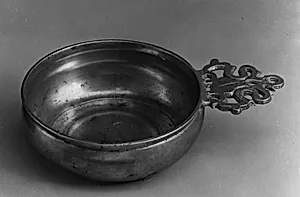
Porringer
Medium
Pewter
Dimensions
Diam. 4 in. (10.2 cm)
Classification
Porringer
Culture
American
Department
The American Wing
Museum
Metropolitan Museum of Art, New York, NY
Credit
Rogers Fund, 1909
Accession Number
09.60.1
Rights
Public Domain
Art Historical Context
Nestled in The American Wing of the Metropolitan Museum of Art this elegant porringer exemplifies the craftsmanship of early 19th-century Americantersmiths Thomas Danforth Boardman and Sherman Boardman. Crafted 1810 and 1850, the shallow bowl with its distinctive handle measures just 4 inches in diameter, making it a perfect fit for everyday use in Federal-era households. Acquired through the Rogers Fund in 9, it stands as a testament to the Boardman family's prominence in New England pewter production. Pewter, an accessible alloy of tin and lead, was a staple of American tableware before widespread industrialization, prized for its silvery sheen and durability. Unlike fragile ceramics or costly silver, it democratized refined dining for the growing middle class. This porringer, likely used for serving porridge to children or as a versatile dish, reflects the practical elegance of domestic life during America's early republic, blending functionality with subtle ornamentation. The Boardmans' work highlights a golden age of American metalwork, where hand-hammered forms preserved colonial traditions while adapting to neoclassical tastes. A charming survivor of daily use, it invites us to imagine family meals in a young nation forging its identity.