
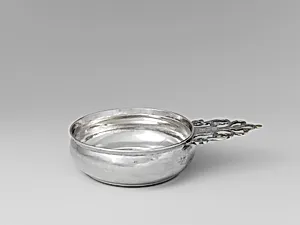
Porringer
ca. 1755
Medium
Silver
Dimensions
Overall: 1 11/16 x 7 3/4 in. (4.3 x 19.7 cm); 7 oz. 9 dwt. (231.4 g) Body: Diam. 5 1/8 in. (13 cm) Lip: Diam. 5 1/8 in. (13 cm)
Classification
Porringer
Culture
American
Department
The American Wing
Museum
Metropolitan Museum of Art, New York, NY
Credit
Bequest of Alphonso T. Clearwater, 1933
Accession Number
33.120.335
Rights
Public Domain
Art Historical Context
This elegant silver porringer, crafted by New York silversmith Jonathan Clarke around 1755, exemplifies the refined craftsmanship of colonial American silverwork. Measuring just 1 11/16 inches high and 5 1/8 inches in diameter, with a weight of over 7 ounces, it features a shallow bowl with a distinctive scroll handle, ideal for serving porridge, caudle, or as a christening gift for infants. Displayed in The Metropolitan Museum of Art's American Wing, it reflects the growing sophistication of American decorative arts in the mid-18th century, when skilled artisans like Clarke blended British influences with local ingenuity. Porringers held both practical and symbolic value in colonial households, serving as status symbols among the prosperous merchant class. Clarke, active in New York during a boom in silver production, hand-raised the vessel from sheet silver, likely employing chasing and repoussé techniques to achieve its smooth, gleaming surfaces. Bequeathed to the Met in 1933 by Alphonso T. Clearwater, this piece offers a tangible link to everyday life in pre-Revolutionary America, highlighting how silver objects bridged utility and artistry in early American culture.