
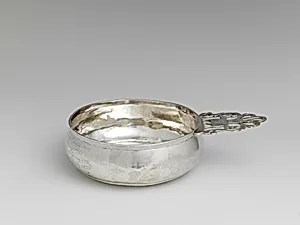
Porringer
1700–1730
Medium
Silver
Dimensions
Overall: 2 1/16 x 8 1/16 in. (5.2 x 20.5 cm); 8 oz. 9 dwt. (262.6 g) Lip: Diam. 5 1/2 in. (14 cm) Body: Diam. 5 9/16 in. (14.1 cm)
Classification
Porringer
Culture
American
Department
The American Wing
Museum
Metropolitan Museum of Art, New York, NY
Credit
Gift of Sylvester Dering, 1915
Accession Number
15.98.2
Rights
Public Domain
Art Historical Context
Step into the refined world of colonial American silver with Samuel Vernon's *Porringer*, crafted 1700 and 1730. This delicate silver vessel, measuring just 2 inches tall and 8 inches across with a substantial weight of 8 ounces 9 pennyweights (262.6 grams), exemplifies silversmith's mastery. Its gently flared body, with a lip diameter of ½ inches, features a classic handle—known as an "ear"— for easy grasping, making it both functional and elegant for everyday dining. In early 18th-century America porringers like this one were essential household items, used for serving porridge, soups, or feeding infants. Silver examples, far from ordinary, signified wealth and status among the colonial elite, often passed down through generations as heirlooms. Vernon's work reflects the burgeoning American decorative arts tradition, blending European influences with local craftsmanship in a time when silversmiths hammered sheets of imported silver into intricate forms, showcasing precision chasing and shaping techniques. Today, this porringer graces The American Wing at The Metropolitan Museum of Art, a gift of Sylvester Dering in 1915. It offers a tangible glimpse into domestic life during America's formative years, highlighting how everyday objects embodied artistry and aspiration.