
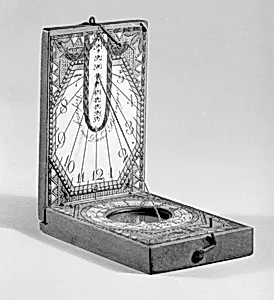
Portable diptych sundial
ca. 1780–1821
Medium
Fruitwood and paper
Dimensions
Overall: 11/16 × 1 3/4 × 2 3/4 in. (1.7 × 4.4 × 7 cm)
Classification
Horology
Culture
German, Nuremberg
Department
European Sculpture and Decorative Arts
Museum
Metropolitan Museum of Art, New York, NY
Credit
Gift of Mrs. Paul R. Hays, in memory of Jacques B. Rice, 1968
Accession Number
68.36
Rights
Public Domain
Art Historical Context
This exquisite portable diptych sund, crafted by David Bering of Nuremberg, Germany, around 1780–1821, exemplifies the masterful horology of late Enlightenment Europe. Nuremberg was a renowned hub for precision instrument makers, blending artistry with scientific ingenuity. Measuring just 11/16 × 1 3/4 × 2 3/4 inches, this pocket-sized marvel folds like a diminutive book, with fruitwood panels housing delicate paper dials. Sundials like this used the sun's shadow via a gnomon (likely a pivoting string or stylus) to tell time across latitudes, making it ideal for travelers, scholars, or merchants navigating an era before widespread pocket watches. The use of fruitwood—prized for its fine grain and workability—highlights exceptional woodworking techniques, while paper elements allowed for precise, customizable engravings of scales and calculations. As a decorative arts object, it reflects the cultural fusion of utility and elegance, where timekeeping became both a practical tool and a status symbol. Donated to the Metropolitan Museum of Art in 1968, this rare survivor invites us to ponder how our ancestors pocketed the cosmos itself.