
Portable Harp
1819
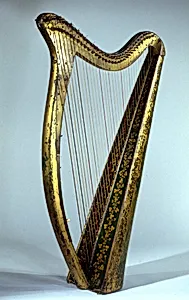
Medium
Wood, various materials
Dimensions
Height: extreme 91.0 cm., Length of pillar 87.0 cm., Soundboard: resonating length 82.6 cm., greatest width 21.2 cm.; Strings: (sounding length) longest 87.0 cm. shortest 8.5 cm. c2 27.0 cm. Perpendicular to floor above soundboard 86.0 cm.
Classification
Chordophone-Harp
Culture
Irish
Department
Musical Instruments
Museum
Metropolitan Museum of Art, New York, NY
Credit
The Crosby Brown Collection of Musical Instruments, 1889
Accession Number
89.4.1083
Rights
Public Domain
Art Historical Context
This Portable Harp, crafted in 1819 by Irish maker John Egan, represents a refined example of early nineteenth-century instrument design. Created in Ireland, the harp reflects a period when traditional Gaelic music was being adapted for domestic and concert settings. Its form, measuring just over three feet in height with a resonating soundboard of 82.6 centimeters, allowed musicians to transport and play the instrument more easily than larger floor harps of earlier centuries. The instrument’s construction from wood and various materials highlights the careful attention to acoustic resonance and structural balance typical of Egan’s workshop. Strings range dramatically in length—from 8.5 to 87 centimeters—producing a full tonal spectrum while maintaining portability. As a chordophone classified within the Metropolitan Museum’s Musical Instruments collection, this harp embodies both practical innovation and the enduring cultural importance of Irish harp traditions. Acquired through the Crosby Brown Collection in 1889, the piece offers visitors a tangible connection to the revival of Irish musical heritage during the Romantic era. Its elegant proportions and thoughtful engineering continue to illustrate how instrument makers responded to changing performance needs while preserving national identity.