
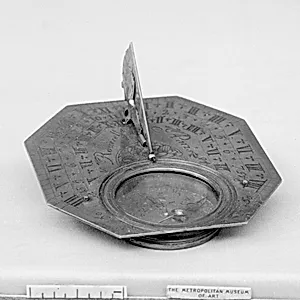
Portable horizontal sundial
first half 18th century
Medium
Brass
Dimensions
Overall: 1 3/8 × 3 1/16 × 2 3/4 in. (3.5 × 7.8 × 7 cm)
Classification
Horology
Culture
French, Paris
Department
European Sculpture and Decorative Arts
Museum
Metropolitan Museum of Art, New York, NY
Credit
Gift of Mrs. Stephen D. Tucker, 1903
Accession Number
03.21.36
Rights
Public Domain
Tags
Art Historical Context
This exquisite portable horizontal sundial, by the Parisian maker Rousselle in the first half of the18th century, exemplifies refined horological artistry of Enlightenment-era France. Made of gleaming brass—a material prized for its durability, malleability, and ability to hold intricate engravings—this pocket-sized instrument measures just 1 3/8 × 3 1/16 × 2 3/4 inches, making it ideal for travelers or gentlemen scholars to carry discreetly. Horizontal sundials like this one were placed flat on a surface to cast shadows from a gnomon (the projecting style), revealing local time via calibrated markings for different latitudes. Produced in Paris, a hub of luxury instrument-making, it reflects the era's fascination with precision and scientific elegance amid the rise of mechanical clocks. Rousselle's work highlights French decorative arts' blend of functionality and ornamentation, where everyday tools became status symbols. Today, housed in the Metropolitan Museum of Art's European Sculpture and Decorative Arts department (gift of Mrs. Stephen D. Tucker, 1903), this sundial invites us to ponder time's timeless allure—before watches dominated, sunlight was our most portable chronometer.