
Portia
Medium
Oil on canvas
Dimensions
49 1/4 x 33 in. (125.1 x 83.8 cm)
Classification
Paintings
Department
European Paintings
Museum
Metropolitan Museum of Art, New York, NY
Credit
Catharine Lorillard Wolfe Collection, Wolfe Fund, 1906
Accession Number
06.1328
Rights
Public Domain
Tags
About this artwork
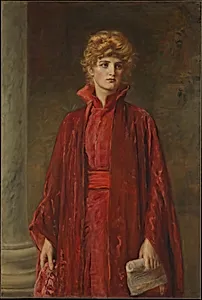
This painting depicts model Kate Dolan in the costume worn by famed actress Ellen Terry in her incarnation as Portia from Shakespeare's "The Merchant of Venice." The figure stands in lawyer's robes, referencing the play's famous courtroom scene where Portia disguises herself as a male attorney to save Antonio from Shylock's bond. X-rays and traces of earlier brushwork reveal that underneath the composition lies a study of the same figure in ancient Greek dress, demonstrating Millais's extensive ...
Art Historical Context
Sir John Everett Millais'sPortia* (1886), an oil on canvas measuring 49¼ × 33 inches, captures the dramatic essence of Shakespeare's *The Merchant Venice*. The painting portrays model Kate Dolan dressed in the lawyer's robes worn by actress Ellen Terry in her famed role as Portia—the clever heroine who disguises herself as a male attorney to outwit Shylock and save Antonio in the play's tense courtroom scene. Long mistaken for Terry herself, this work highlights Millais's fascination withan themes and Victorian theater during the late 19th century. By 1886, forty years into his career, Millais had transformed from a fiery Pre-Raphaelite Brotherhood founder—known for meticulous detail and vivid realism—into one of Britain's most celebrated painters. His rich palette of crimsons and golds lends the figure a commanding, regal presence, emphasizing Portia's intellect and poise. X-rays reveal a fascinating underlayer: an earlier study of the same model in ancient Greek dress, showcasing Millais's iterative process and commitment to refining his compositions. Housed in the Metropolitan Museum of Art's European Paintings department (Catharine Lorillard Wolfe Collection, 1906), *Portia* bridges literature, theater, and portraiture, inviting viewers to ponder gender roles and performative identity in Victorian society. It's a testament to Millais's enduring ability to blend historical drama with artistic innovation.