
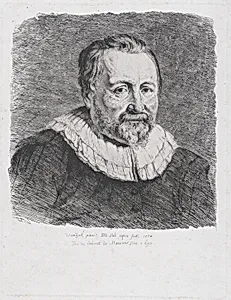
Portrait, after Van Dyck
Medium
Etching; fourth state of five
Dimensions
Sheet: 14 9/16 × 10 1/4 in. (37 × 26 cm) Plate: 9 1/2 × 7 5/16 in. (24.1 × 18.5 cm)
Classification
Prints
Department
Drawings and Prints
Museum
Metropolitan Museum of Art, New York, NY
Credit
Gift of Mrs. Algernon S. Sullivan, 1919
Accession Number
19.56.43
Rights
Public Domain
Tags
Art Historical Context
This striking etching, titled *Portrait after Van Dyck*, the elegance of a 17th-century nobleman through the skilled hand of Jean-Jacques de Boieu, a French artist born in 1736. Created in 1770, it reproduces an original portrait by the Baroque master Anthony van Dy (1599–1641), renowned for his luminous of European aristocracy, including England's King Charles I and his court. Boissieu's work exemplifies 18th-century fascination with old masters, where engravers like him revived classical portraits for new audiences through accessible prints. As a fourth state of five in the etching process, this impression reflects refinements in Boissieu's technique—etchings involve biting acid into a metal plate to create intricate lines, allowing for rich tonal depth and subtle shading that mimic Van Dyck's fluid brushwork. Measuring about 9½ × 7⅜ inches on the plate, its compact scale made it ideal for collectors' albums. Housed in the Metropolitan Museum of Art's Drawings and Prints department since a 1919 gift, this print highlights etching's role in democratizing art history, bridging Baroque grandeur with Enlightenment-era appreciation for portraiture's psychological insight. (198 words)
About the Artist
Jean Jacques de Boissieu|Anthony van Dyck · 1736–1810
French, Lyons 1736–1810 Lyons