
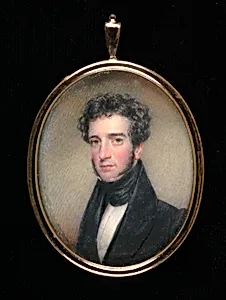
Portrait of a Gentleman
ca. 1840
Medium
Painting-Miniature
Classification
Painting-Miniature
Department
Smithsonian Collection
Museum
Smithsonian American Art Museum
Credit
Smithsonian American Art Museum, Gift of Mrs. Henry L. Milmore
Accession Number
1950.4.37
Rights
Public Domain
Tags
About this artwork
This gentleman’s clothing reflects mid-nineteenth-century tastes, when men wore darker colors, particularly black and blue, to convey a sense of sobriety and professionalism in a new middle-class society. His thick curly hair, sideburns, and tender expression, however, suggest a romantic side to his personality.
Art Historical Context
Step into the intimate world of 19th portrait miniatures with *Portrait of a Gentleman*, delicate bust-length painting created around 1840 by an unidentified artist. Housed in the Smithsonian American Art Museum, this tiny masterpiece—likely executed in watercolor on ivory, the hallmark medium of miniatures—exemplifies a cherished art form. Miniatures were personal treasures, often worn as lockets or brooches, capturing loved ones in exquisite detail for everyday companionship during an era of expanding travel and family separations. The gentleman's attire speaks volumes about mid-19th-century American tastes. Darker hues of black and blue dominated men's fashion, signaling sobriety and professionalism amid the rise of a burgeoning middle class. Yet, his thick, curly hair, prominent sideburns, and soft, tender expression reveal a romantic undercurrent, blending restraint with personal warmth. This contrast mirrors the era's cultural shifts, where Victorian propriety coexisted with lingering Romantic ideals. As a gift to the museum from Mrs. Henry L. Milmore, this anonymous portrait invites us to ponder the everyday heroes of history—perhaps a merchant, lawyer, or family patriarch—whose stories endure through such finely wrought likenesses.
About the Artist
Unidentified ( ) · –