
Portrait of a Girl
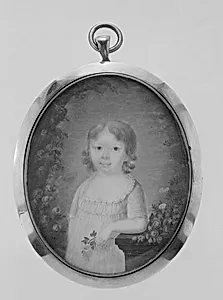
Medium
Watercolor on ivory
Dimensions
2 11/16 x 2 3/16 in. (6.9 x 5.5 cm)
Classification
Painting, miniature
Culture
American
Department
The American Wing
Museum
Metropolitan Museum of Art, New York, NY
Credit
Dale T. Johnson Fund, 2006
Accession Number
2006.235.152
Rights
Public Domain
Tags
Art Historical Context
In the late 18th century, the young United States forged its identity after the Revolution, intimate miniature portraits like *Portrait of a Girl* (1797) by Philippe Peticolas captured the elegance and innocence of American youth. This exquisite watercolor on ivory, measuring just 2 11/16 x 2 3/16 inches, exemplifies the artist's skill in rendering lifelike details on a tiny, luminous surface. Peticolas a French-born painter active in Philadelphia and Richmond Virginia, specialized in these jewel-like works, which were often worn as lockets or brooches by affluent families as cherished keepsakes. The choice of ivory as a support was no accident—its smooth, translucent quality allowed watercolor pigments to glow with a pearl-like sheen, enhancing the subject's delicate features and soft coloring. This technique, rooted in European traditions but adapted to American tastes, highlights the Federal era's blend of refinement and emerging national pride. Displayed in The Metropolitan Museum of Art's American Wing, the portrait invites us to ponder the unnamed girl's story: perhaps a daughter of the emerging merchant class, her gaze frozen in time as a symbol of hope and continuity. Today, such miniatures remind us of portraiture's personal power before photography, offering a window into everyday lives of early American girls amid a transforming nation.