
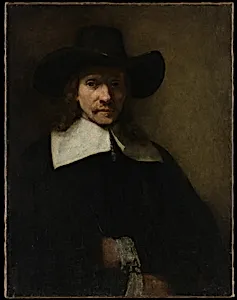
Portrait of a Man
ca. 1655–60
Medium
Oil on canvas
Dimensions
32 7/8 x 25 3/8 in. (83.5 x 64.5 cm)
Classification
Paintings
Department
European Paintings
Museum
Metropolitan Museum of Art, New York, NY
Credit
Marquand Collection, Gift of Henry G. Marquand, 1890
Accession Number
91.26.7
Rights
Public Domain
Tags
Art Historical Context
This striking *Portrait of a Man*, by the Dutch master Rembrandt van Rijn around 1655–60, the artist's profound skill in Baroque portraiture during the Dutch Golden Age. Oil on canvas, measuring 32⅞ × 25⅜ inches, it captures the sitter with intense realism and emotional depth, a hallmark of's mature style. Acquired through the Marquand Collection and to the Metropolitan Museum of Art in 1890, it resides in the European Paintings departmentRembrandt's innovative use of chiaroscuro—dramatic contrasts of light and shadow—draws the viewer's eye to the man's face, illuminating his thoughtful gaze and textured features. Broad, expressive brushstrokes and layered glazes create a lifelike skin tone and fabric folds, showcasing oil painting's versatility for psychological intimacy. This period marked Rembrandt's financial struggles and artistic evolution toward looser, more improvisational techniques. As a quintessential example of 17th-century Dutch portraiture, the work reflects the era's emphasis on individual character over idealization, inviting visitors to ponder the man's identity and inner life. A testament to Rembrandt's enduring legacy, it reminds us of art's power to humanize history.
About the Artist
Rembrandt (Rembrandt van Rijn) · 1606–1669
Rembrandt Harmenszoon van Rijn (1606–1669) stands as one of the greatest visual artists in the history of Western art and the most important Dutch painter of the 17th century. Born in Leiden to a prosperous miller's family, Rembrandt transformed painting through his revolutionary use of light and shadow, his psychological depth in portraiture, and his elevation of etching to a fine art. His approx...