
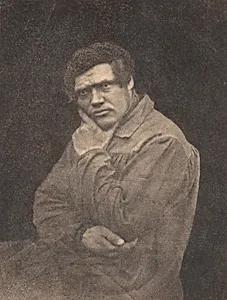
Portrait of a Man
late 1840s
Medium
salted paper print
Dimensions
overall: 14.5 x 11.3 cm (5 11/16 x 4 7/16 in.)
Classification
Photograph
Department
CPH
Museum
National Gallery of Art, Washington, D.C.
Credit
Robert B. Menschel Fund
Accession Number
1998.53.1
Rights
Public Domain
Art Historical Context
Step into the dawn of photography with *Portrait of a Man* by Baron Louis-Adol Humbert de Molard a French nobleman and pioneering photographer. Created in the late 1840s, this intimate salted paper print measures just 14.5 x 11.3 cm, inviting visitors to lean in close. The baron, an amateur innovator from Normandy, captured everyday subjects during photography's infancy, blending aristocratic curiosity with technical daring. Salted paper prints, developed from William Henry Fox Talbot's calotype process around 1840, marked a revolutionary shift. Unlike the one-of-a-kind daguerreotypes, this method used paper negatives to produce multiple positive prints: paper was salted with sodium chloride, coated in silver nitrate, and exposed to light in a "printing-out" technique that revealed images gradually. The soft, textured tones and subtle details in this portrait exemplify the medium's poetic charm, forever fixing a man's gaze amid the era's excitement over "drawing with light." Housed in the National Gallery of Art's photography collection through the Robert B. Menschel Fund, this work highlights photography's cultural leap—from novelty to art. It reminds us how 19th-century pioneers like Humbert de Molard transformed portraiture, offering unprecedented realism and preserving fleeting humanity in silver and salt.