
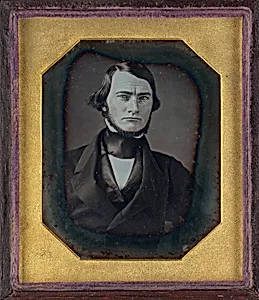
Portrait of a Man
c. 1855
Medium
daguerreotype
Dimensions
image (visible): 6.7 × 5.5 cm (2 5/8 × 2 3/16 in.) mat: 8.2 × 7 cm (3 1/4 × 2 3/4 in.) case (closed): 9.2 × 7.9 cm (3 5/8 × 3 1/8 in.)
Classification
Photograph
Department
CPH
Museum
National Gallery of Art, Washington, D.C.
Credit
Gift of Mary and Dan Solomon
Accession Number
2006.170.17
Rights
Public Domain
Art Historical Context
Step into the dawn of photography with *Portrait of a Man*, a circa 1855 daguerreotype created by an anonymous American photographer. This intimate portrait captures the stern gaze and finely detailed features of its subject against a neutral backdrop, rendered in the medium's signature mirror-like sheen. Measuring just 6.7 × 5.5 cm in its visible image, it exemplifies the petite scale of daguerreotypes—small enough to carry in a pocket or locket, making personal likenesses accessible to the growing middle class. Invented in 1839 by Louis Daguerre, the daguerreotype process involved polishing a silver-plated copper sheet, sensitizing it with chemicals, and exposing it to light for several minutes. The result was a one-of-a-kind positive image, prized for its astonishing clarity and depth but fragile and non-reproducible. By the 1850s, as seen here, it had become America's premier portrait medium, revolutionizing how people preserved their identities amid rapid industrialization and westward expansion. Housed in the National Gallery of Art's Department of Photographs (CPH) through the generous gift of Mary and Dan Solomon, this work whispers of mid-19th-century optimism and innovation. Gaze closely: every whisker and fabric texture tells a story of a technology that bridged painting and reality, forever changing portraiture.
About the Artist
American 19th Century · 1800–1900
The artist cataloged as "American, 19th Century" represents a collective of unidentified painters active in the United States during the nineteenth century, with 380 known artworks preserved in this virtual museum's collection. These works span a diverse array of genres typical of the era, including portraits, landscapes, still lifes, and genre scenes, reflecting the burgeoning artistic output of ...