
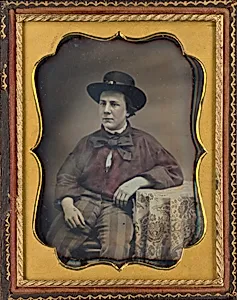
Portrait of a Man
c. 1850
Medium
daguerreotype with applied color
Dimensions
image (visible): 9.4 × 6.7 cm (3 11/16 × 2 5/8 in.) mat: 10.8 × 8.2 cm (4 1/4 × 3 1/4 in.) case (closed): 12 × 9.5 × 1.8 cm (4 3/4 × 3 3/4 × 11/16 in.)
Classification
Photograph
Department
CPH
Museum
National Gallery of Art, Washington, D.C.
Credit
Alfred H. Moses and Fern M. Schad Fund
Accession Number
2017.3.2
Rights
Public Domain
Art Historical Context
Step into the dawn of photography with *Portrait of a Man*, captivating daguerreotype from around 1850, created by an anonymous American photographer. Dating to the medium's exciting early years—just a decade after Louis Daguerre's 1839 invention—this small, precious image (measuring just 9.4 × 6.7 cm) captures stern gaze of its unidentified subject against a neutral backdrop. Housed in a protective case typical of the era, it now graces the National Gallery of Art, thanks to the Alfred H. Moses and Fern M. Schad Fund. What makes this portrait shine is its pioneering technique: a daguerreotype, produced on a silver-plated copper sheet polished to a mirror-like finish, exposed in a camera, and developed with mercury vapor. The subtle applied color—hand-painted highlights on cheeks, lips, and clothing—adds a lifelike warmth, bridging the gap between stiff photography and painted portraiture. These enhancements were a popular 19th-century flourish, making formal likenesses feel personal and vivid. In mid-19th-century America, daguerreotypes revolutionized portraiture, making professional portraits affordable to the growing middle class and preserving everyday faces for posterity. This intimate work exemplifies how photography quickly became a cultural phenomenon, democratizing memory in an era of rapid change—from the Gold Rush to industrialization. A tiny window into a vanished world!
About the Artist
American 19th Century · 1800–1900
The artist cataloged as "American, 19th Century" represents a collective of unidentified painters active in the United States during the nineteenth century, with 380 known artworks preserved in this virtual museum's collection. These works span a diverse array of genres typical of the era, including portraits, landscapes, still lifes, and genre scenes, reflecting the burgeoning artistic output of ...