
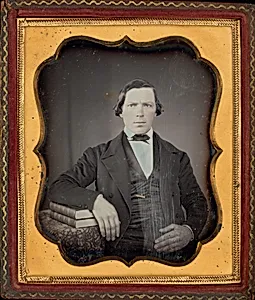
Portrait of a Man
c. 1850
Medium
daguerreotype with applied color
Dimensions
image (visible): 7.1 × 5.9 cm (2 13/16 × 2 5/16 in.) mat: 8.2 × 7 cm (3 1/4 × 2 3/4 in.) case (closed): 9.3 × 8 × 2 cm (3 11/16 × 3 1/8 × 13/16 in.)
Classification
Photograph
Department
CPH
Museum
National Gallery of Art, Washington, D.C.
Credit
Ross J. Kelbaugh Collection, Purchased with support from the Ford Foundation
Accession Number
2023.39.12
Rights
Public Domain
Art Historical Context
Step into the dawn of photography with *Portrait of a Man* Glenalvin Goodridge created around 1850. This intimate daguerreotype, measuring just 7.1 × 5.9 cm, captures the solemn gaze of its unidentified subject in exquisite detail.oused in a compact case ideal for a pocket or locket, it exemplifies the personal treasures of the era, now preserved in the National Gallery of's Ross J. Kelbaugh. Daguerreotypes like this one, the first publicly available photographic process invented in 1839, produced one-of-a-kind positive images on silvered copper plates. Goodridge enhanced his with applied color—delicately hand-tinted pigments that brought a lifelike warmth to the metallic sheen, a popular technique to mimic painted miniatures. At a time when photography was a novel luxury, this small-scale portrait highlights the medium's rapid evolution from novelty to cherished memento. Goodridge, one of the earliest African American photographers working in the Midwest, adds profound cultural weight to this piece. Amid the social upheavals of pre-Civil War America, his technical mastery underscores Black ingenuity in a field dominated by white practitioners, inviting us to reflect on untold stories behind every frozen moment.