
Portrait of a Man
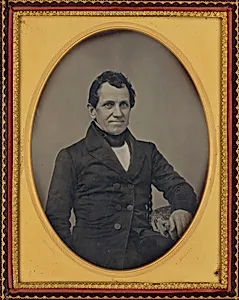
Medium
daguerreotype
Dimensions
image (visible): 12.1 × 9 cm (4 3/4 × 3 9/16 in.) mat: 14.2 × 10.9 cm (5 9/16 × 4 5/16 in.) case (closed): 15.2 × 12.4 × 2.2 cm (6 × 4 7/8 × 7/8 in.)
Classification
Photograph
Department
CPH
Museum
National Gallery of Art, Washington, D.C.
Credit
Gift of Mary and Dan Solomon
Accession Number
2025.12.3
Rights
Public Domain
Art Historical Context
Step into the dawn of photography with *Portrait of a Man*, circa 1848 daguerreotype pioneering American photographers Marcus Aurelius Root and his Samuel Root. Captured a tiny silvered copper plate measuring just 12.1 × 9 cm, this intimate image exemplifies the daguerreotype process—photography's first practical method, introduced by Louis Daguerre in 9. The Roots, who ran successful studios in Philadelphia and Washington D.C., mastered this technique, producing sharp, mirror-like portraits that captured the Victorian era's poised formality. Daguerreotypes like this one were revolutionary, offering unprecedented realism and detail without the need for painting skills, making portraiture accessible beyond the elite. The process involved exposing a polished plate to mercury vapor and light, then fixing the image with gold chloride—a delicate, one-of-a-kind creation housed in a protective case (15.2 × 12.4 × 2.2 cm closed). Viewed at an angle, the image shimmers ethereally, inviting close inspection. This gift to the National Gallery of Art from Mary and Dan Solomon highlights photography's cultural shift: from artisanal craft to mass medium. In 1848 America, such portraits preserved identity amid rapid change, blending art and science in a single, gleaming glance.