
Portrait of a Man
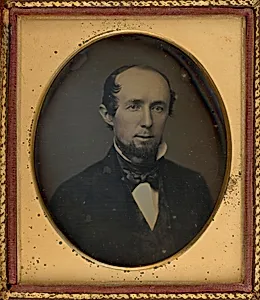
Medium
daguerreotype
Dimensions
image (visible): 7.1 × 5.9 cm (2 13/16 × 2 5/16 in.) mat: 8.2 × 6.8 cm (3 1/4 × 2 11/16 in.) case (closed): 9.2 × 8.2 × 1.6 cm (3 5/8 × 3 1/4 × 5/8 in.)
Classification
Photograph
Department
CPH
Museum
National Gallery of Art, Washington, D.C.
Credit
Gift of Mary and Dan Solomon
Accession Number
2025.12.5
Rights
Public Domain
Art Historical Context
Step into the dawn of photography with *Portrait of a Man*, captivating daguerreotype created around 1848 by brothers Marcus Aurelius Root and Root, pioneering American photographers. This intimate image, measuring just 7.1 × 5.9 cm, captures the solemn gaze of an unidentified sitter against a simple backdrop, housed in a protective case typical of the era. The Roots, who ran successful studios in Philadelphia and beyond, were masters of this nascent medium, blending artistry with technical innovation. Daguerreotypes like this one—made on silvered copper plates exposed to mercury vapor—represent a photographic revolution just a decade after Louis Daguerre's 1839 invention. Requiring long exposures of several minutes, they produced one-of-a-kind, mirror-like positives with exquisite detail, far surpassing painted miniatures in precision and affordability. This tiny portrait, now in the National Gallery of Art's collection (gift of Mary and Dan Solomon), exemplifies mid-19th-century portraiture's cultural shift: photography democratized likenesses, preserving personal identity for families and travelers. Its survival highlights the fragility and allure of early photos—viewable only from specific angles under light. A window into 1840s America, it invites us to ponder the man's story, frozen in silver for eternity.