
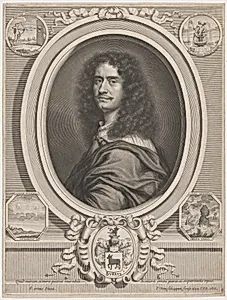
Portrait of a Man
Medium
engraving
Dimensions
sheet: 35.8 × 27.2 cm (14 1/8 × 10 11/16 in.)
Classification
Department
CG-E
Museum
National Gallery of Art, Washington, D.C.
Credit
Rosenwald Collection
Accession Number
1950.14.54
Rights
Public Domain
Art Historical Context
Created in 1675 by Flemish-born engraver Peter Ludwig van Schuppen, this striking portrait exemplifies the refined printmaking traditions of the late Baroque period. Working primarily in Paris after training in Antwerp, van Schuppen specialized in translating painted portraits into detailed engravings, allowing images of notable figures to circulate widely across Europe. The work’s substantial sheet size—35.8 by 27.2 centimeters—suggests it was intended as a display piece rather than a book illustration. Engraving, the medium employed here, involves incising fine lines into a copper plate with a burin, a technique prized for its precision and ability to capture subtle tonal gradations through cross-hatching. In the 17th century, such prints played a vital cultural role, democratizing access to portraiture that had once been reserved for oil paintings in private collections. This example, now part of the Rosenwald Collection at the National Gallery of Art, preserves both the likeness of its unknown sitter and the technical mastery of its creator. Though the identity of the man remains unknown, the formal pose and meticulous rendering reflect the period’s emphasis on dignity and status. Van Schuppen’s work thus offers modern viewers a window into 17th-century European conventions of representation and the enduring power of printmaking to shape public memory.