
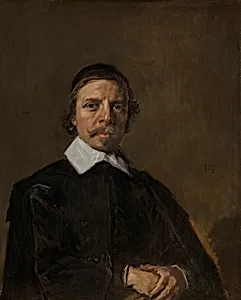
Portrait of a Man, possibly a Clergyman
Frans Hals, c. 1657 - c. 1660
About this artwork
Frans Hals, a master of the Dutch Golden Age painted this intimate *Portrait of a Man, a Clergyman* 1657–1660, during the later phase of his illustrious career in Haarlem. The small oil-on-panel work (37.1 × 29.8 cm) depicts an unidentified sitter seated half-length, his hands serenely folded over his stomach—a gesture evoking quiet contemplation or clerical piety. Housed in Amsterdam's Rijksmuseum, exemplifies Hals' skill in capturing everyday dignity amid the prosperous Dutch Republic. Hals' signature loose, bravura brushwork shines here, with fluid strokes rendering the man's dark clothing and subtle facial expression with remarkable vitality. Unlike the stiff formality of many period portraits, Hals infuses a sense of immediacy, using rapid, visible dabs of paint to suggest texture and light—techniques that influenced later artists like the Impressionists. Oil on panel, a durable medium favored for portable, detailed studies, allowed Hals to achieve luminous depth on this compact scale. This portrait offers a window into 17th-century Dutch society, where Protestant clergy played key roles in a Calvinist culture emphasizing modesty and introspection. Though the man's identity remains a mystery, Hals elevates him to timeless resonance, blending realism with psychological insight in a gem of Baroque portraiture.