
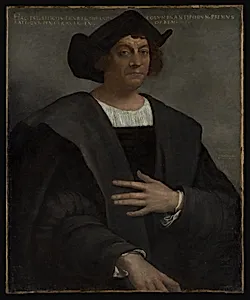
Portrait of a Man, Said to be Christopher Columbus (born about 1446, died 1506)
Medium
Oil on canvas
Dimensions
42 x 34 3/4 in. (106.7 x 88.3 cm)
Classification
Paintings
Department
European Paintings
Museum
Metropolitan Museum of Art, New York, NY
Credit
Gift of J. Pierpont Morgan, 1900
Accession Number
00.18.2
Rights
Public Domain
Tags
Art Historical Context
This striking *Portrait of a Man, to be Christopher Columbus* (1519), painted by Sebastiano del Pi, captures the essence of High Renaissance portraiture. Sebastiano, a Venetian artist who later worked in Rome under Michelangelo's influence, masterfully rendered the sitter in oil on canvas—a medium he helped popularize in Venice for its luminous depth and detail. The painting's intimate scale (42 x 34¾ inches) draws viewers close to the man's contemplative gaze and richly textured black attire, evoking quiet authority and introspection. Traditionally identified as the famed explorer Christopher Columbus (c. 1446–1506), the portrait was created just over a decade after his death, amid growing legends of his voyages to the New World. While its attribution sparks debate among scholars—due to stylistic ideals over literal likeness—it exemplifies Renaissance fascination with heroic figures. Sebastiano's technique, blending Venetian color with Roman monumentality, imbues the figure with gravitas, highlighting fur collar and gloved hand as symbols of status. Housed in the Metropolitan Museum of Art's European Paintings department (gift of J. Pierpont Morgan, 1900), this work invites us to ponder discovery's human face—ambitious, enigmatic, and enduring.