
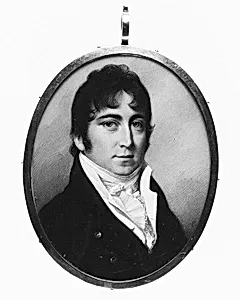
Portrait of a Man, Said to Be Mr. De Wolf
ca. 1805
Medium
Ivory
Dimensions
Oval, 3 1/4 x 2 1/2 in. (81 x 62 mm)
Classification
Miniatures
Department
European Paintings
Museum
Metropolitan Museum of Art, New York, NY
Credit
Gift of Alfred Ram, 1911
Accession Number
11.218
Rights
Public Domain
Tags
Art Historical Context
George Engleheart's *Portrait of a Man, Said to Be Mr. De* (ca. 1805) captures the refined elegance of early 19th-century British portraiture in miniature form. Painted on ivory in an oval format measuring just 3¼ x 2½ inches, this delicate work exemplifies the intimate scale of miniatures which were prized as personal keepsakes, lockets, or jewelry.oused in the Metropolitan Museum of Art's European Paintings department and classified as a miniature, it entered the collection as a gift Alfred Ram in 191. Engleheart, one of England's most celebrated miniaturists, produced thousands of such portraits during his career, blending watercolor techniques with meticulous detail to achieve lifelike expressions and subtle textures on the smooth ivory surface. Active in the late Georgian and Regency eras, he drew from the traditions of artists like Richard Cosway, favoring soft lighting and naturalistic poses that conveyed the sitter's character—here, possibly the enigmatic Mr. De Wolf, whose identity remains traditionally ascribed rather than confirmed. Miniatures like this held cultural significance as affordable alternatives to grand oil portraits, democratizing fine art for the emerging middle class while serving romantic or memorial purposes. This piece invites visitors to appreciate the technical virtuosity required for such tiny masterpieces, evoking an era when portraiture was both personal treasure and social statement.