
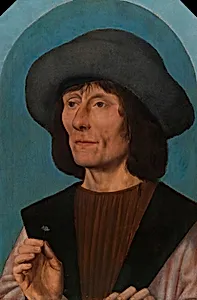
Portrait of a Man with a Pink
1500–10
Medium
Oil on panel
Dimensions
43.8 × 29.2 cm (17 1/4 × 11 1/2 in.); Framed: 51.8 × 36.9 × 4.5 cm (20 3/8 × 14 1/2 × 1 3/4 in.)
Classification
oil on panel
Department
Painting and Sculpture of Europe
Museum
Art Institute of Chicago
Accession Number
864
Rights
Public Domain
About this artwork
In this portrait from relatively early in his career, Quentin Massys followed stylistic conventions that appealed to Antwerp’s growing market of patrons while also exhibiting the bold innovations that ultimately made him one of city’s most influential painters. The sitter appears frozen in a somewhat unnatural pose, as was the fashion for half-length portraits at the time, and the positioning of his left hand on the painting’s lower edge recalls the spatial illusionism found in portraits by Neth...
Art Historical Context
Quentin Massys, a leading painter of the Antwerp school, created this sensitive half-length portrait between 1500 and 0. Working at the height of the Northern Renaissance, Massys blended meticulous Flemish detail with emerging Italianate interests in human character and spatial clarity. The small oil-on-panel format, measuring just 43.8 by 29.2 centimeters, was well suited to private contemplation or display in a prosperous merchant’s home. The sitter holds a pink carnation, a flower often included in early-sixteenth-century portraits to suggest affection, betrothal, or remembrance. Massys’s command of oil paint allows the delicate petals, the sheen of the man’s black garment, and the subtle modeling of his features to emerge with luminous precision. Such works reflect the growing demand among Europe’s urban elite for individualized likenesses that conveyed both status and inner life. Today in the Art Institute of Chicago, the painting offers visitors a vivid glimpse of Renaissance portraiture at its most intimate and technically refined.