
Portrait of a Prince
Unknown Artist
17th century
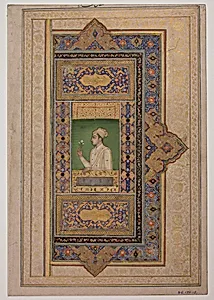
Medium
Ink, watercolor, and gold on paper
Dimensions
H. 8 1/4 in. (21 cm) W. 4 1/2 in. (11.4 cm)
Classification
Codices
Department
Islamic Art
Museum
Metropolitan Museum of Art, New York, NY
Credit
Bequest of George D. Pratt, 1935
Accession Number
45.174.19
Rights
Public Domain
Tags
Art Historical Context
This exquisite *Portrait of a Prince*, by an unknown artist in the 17 century, captures the refined elegance of Islamic miniature painting. Rendered in ink, watercolor, and gold paper, the small-scale work (8 1/4 x 4 1/2 inches) depicts a noble figure in profile, surrounded by delicate floral motifs—a common emblem of beauty and paradise in Persianate art. Likely a leaf from a codex or album, it exemplifies the intricate book arts of the Islamic world, where such portraits adorned manuscripts, albums, or princely collections. Hailing from the Islamic Art tradition, this piece reflects the Safavid or Mughal era's mastery of portraiture, where artists celebrated royal patrons with idealized features, ornate turbans, and vibrant patterns. The use of gold leaf adds a luminous, jewel-like quality, enhancing the portrait's status as a luxury object fit for a courtly audience. Techniques like fine-line ink drawing and layered watercolors allowed for hyper-detailed rendering, blending realism with stylized grace. Bequeathed to the Metropolitan Museum of Art in 1935 by George D. Pratt, this artwork invites visitors to appreciate the cultural prestige of 17th-century Islamic princely imagery, where flowers symbolized eternal youth and divine favor, bridging art, poetry, and power in the opulent courts of Persia, India, or the Ottoman Empire.