
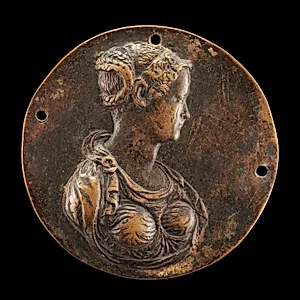
Portrait of a Woman
second half 16th century
Medium
bronze//Three times pierced
Dimensions
overall (diameter): 6.78 cm (2 11/16 in.) gross weight: 59.74 gr (0.132 lb.)
Classification
Sculpture
Department
CSD
Museum
National Gallery of Art, Washington, D.C.
Credit
Samuel H. Kress Collection
Accession Number
1957.14.1106
Rights
Public Domain
Art Historical Context
This bronze portrait medal, created in northern Italy during the second half of the sixteenth century, offers a glimpse into Renaissance ideals of individual commemoration. Attributed simply to a “North Italian” artist, the work reflects the period’s widespread interest in portrait as a means of preserving likeness and status. Small bronzes like this one often commissioned by merchants, nobles, scholars who wished to distribute their image among friends and patrons, much like an early form of calling card or keepsake. Measuring just under seven centimeters across, the medal was cast in bronze—a durable and prestigious medium favored in Renaissance workshops for its ability to capture fine detail while withstanding time. The three piercings suggest it may once have been worn as jewelry or mounted on a book cover or frame, transforming a sculptural object into a personal talisman. Such practical adaptations highlight how art objects moved fluidly between private and public spheres during this era. Today in the National Gallery of Art’s Samuel H. Kress Collection, the medal continues to speak to the intimate scale of Renaissance portraiture and the enduring appeal of bronze as both artistic and functional material.