
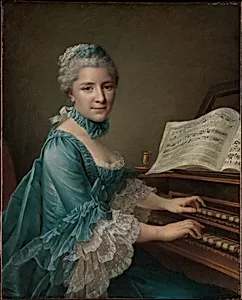
Portrait of a Woman, Said to be Madame Charles Simon Favart (Marie Justine Benoîte Duronceray, 1727–1772)
Medium
Oil on canvas
Dimensions
31 1/2 x 25 1/2 in. (80 x 64.8 cm)
Classification
Paintings
Department
European Paintings
Museum
Metropolitan Museum of Art, New York, NY
Credit
Mr. and Mrs. Isaac D. Fletcher Collection, Bequest of Isaac D. Fletcher, 1917
Accession Number
17.120.210
Rights
Public Domain
Tags
Art Historical Context
In this enchanting 1757 portrait, François Hubert Drouais captures the poised elegance of a woman said to be Madame Charles Simonart (Marie Justine Benoîte Duronceray, 1727–1772), a celebrated French actress and singer at the Opéra-Comique Painted in oil on canvas, the bust-length composition measures 31½ × 25½ inches and showcases Drouais's mastery of Rococo portraiture. His fluid brushwork and soft, luminous highlights bring a sense of refined grace, typical of the playful, ornate style that flourished under Louis XV. Madame Favart, wife of theater director Charles-Simon Favart, embodied the vibrant cultural scene of mid-18th-century Paris, where music and drama intertwined. The painting's musical instruments—evident in its tagging—likely nod to her talents as a performer, blending portraiture with symbols of artistic patronage. Drouais, a favored court painter known for flattering yet lifelike depictions of the elite, elevates her as a muse of Enlightenment-era leisure. Now in the Metropolitan Museum of Art's European Paintings department (from the Isaac D. Fletcher bequest), this work offers a window into pre-Revolutionary France's fascination with music and femininity, reminding visitors of the era's stars who dazzled both stage and salon.
About the Artist
François Hubert Drouais · 1727–1775
He was a fashionable portraitist. He is best known for portraits of children and one of Mme de Pompadour from 1763, completed after her death. Comment on works: Portraits